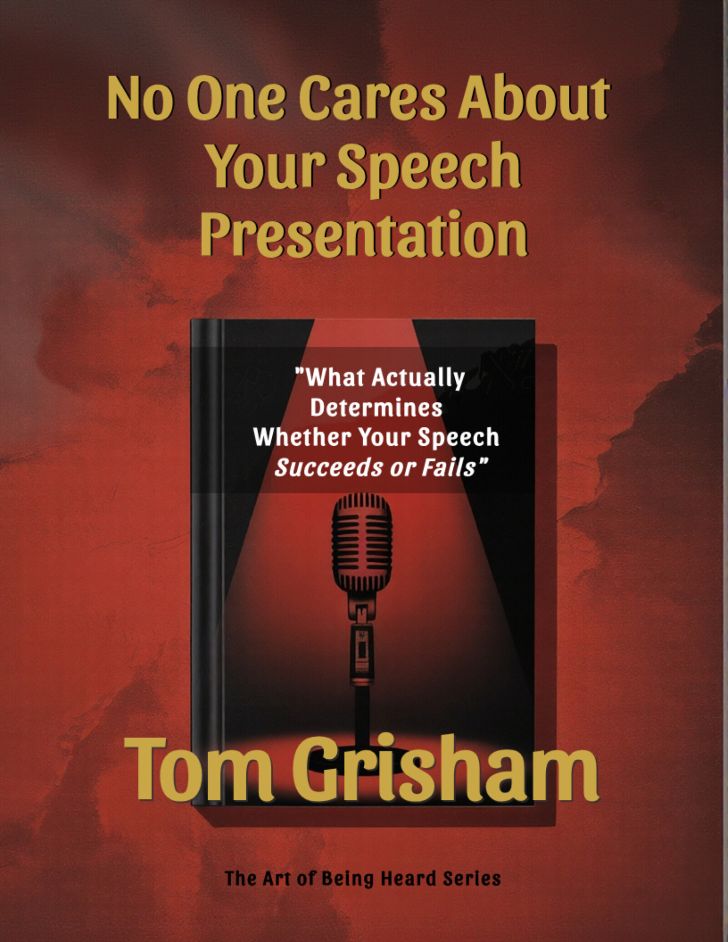
No One Cares About Your Speech Presentation
Have you ever noticed how much sleep we lose over the “theater” of a presentation? We spend weeks obsessing over the exact shade of blue on our slides or whether our tie is perfectly straight, as if the audience is sitting there with a scorecard, waiting for us to slip up. But if you have ever sat in the audience yourself, you know that you weren’t looking for a perfect performance. You were likely just hoping the person at the front of the room had something helpful to say that might make your life a little easier.
It is a curious thing, but the secret to being a great speaker starts with a very humbling realization: No one actually cares about your “presentation.” They care about themselves, their problems, and their time. In my new book, No One Cares About Your Speech Presentation, I want to invite you to put down the heavy burden of being a performer and pick up the much lighter tool of being a helper. Once you realize the audience is on your side—because they want you to succeed so they can learn—the podium stops feeling like a barrier and starts feeling like a bridge.
$4.45
Standing in front of a room full of people is often described as a nightmare, but I have always seen it as an opportunity for connection. We worry so much about our notes and our slides that we forget why we are up there in the first place. The truth is, people are not looking for perfection; they are looking for something useful. This is the heart of the new eBook, No One Cares About Your Speech Presentation, where we strip away the ego and focus on what actually moves an audience.
I remember my first real talk in a small community hall. I was sweating through my shirt, clutching a stack of index cards like a lifeline, only to realize halfway through that nobody was looking at my cards—they were looking at me. They wanted to know if I had something to say that might help them. That realization changed everything for me. It turned a chore into a conversation.
This book guides you through that same transition.
What You Will Discover
Chapter 1: What Public Speaking Is Really About
It is not a performance or a test of your worth, but a simple act of service to your listeners. When you shift your focus from yourself to the people in the seats, the pressure begins to melt away.
Chapter 2: An In-depth Exploration into Public Speaking
We look at the history and the mechanics of why humans share ideas verbally. Understanding the “why” behind the tradition makes the “how” feel much more natural.
Chapter 3: Public Speaking and You
Your unique voice is your greatest asset, even if you think it is too quiet or unpolished. This chapter helps you find a style that feels like you, rather than a character you are playing.
Chapter 4: Your First Time Giving a Speech
The initial hurdle is always the highest, but it does not have to be a fall. We talk about how to navigate those first few minutes when your heart is racing the fastest.
Chapter 5: Displaying Confidence while Speaking
Confidence is often just a result of being prepared and being honest. You will learn how to stand and move in a way that shows you are comfortable in your own skin.
Chapter 6: Controlling Your Fear is Easily Done
Fear is just energy that hasn’t found a place to go yet. We explore simple ways to take that nervous buzz and turn it into enthusiasm for your topic.
Chapter 7: Selecting Your Topic to Speak About
The best speeches come from things you actually care about. We discuss how to find the intersection between what you know and what your audience needs to hear.
Chapter 8: Understanding Your Audience
Before you write a single word, you have to know who is listening. Learning their hopes and their struggles allows you to speak directly to their hearts.
Chapter 9: Getting Your Speech Organized
A messy speech leaves people confused, and confused people stop listening. We walk through how to build a clear path from your opening thought to your final point.
Chapter 10: Mapping Out Your Speech
Think of this as your GPS for the presentation. You will learn how to create a logical flow that keeps both you and your audience on track.
Chapter 11: Effectively Preparing Your Visual Aids
Slides should support you, not replace you or distract the room. We look at how to keep things simple so the focus stays on the message.
Chapter 12: Communicating Your Message Effectively
Words are only part of the story; tone and timing matter just as much. This chapter covers how to deliver your points so they actually stick in people’s minds.
Chapter 13: Concluding Inquiries
The end of the speech is often where the real learning starts. We discuss how to handle questions with grace and keep the dialogue going after you finish.
Learning to speak well is really just learning to be more fully yourself in front of others. It is a skill that opens doors and builds bridges in every part of life.
We learn best when we are willing to listen as much as we talk.