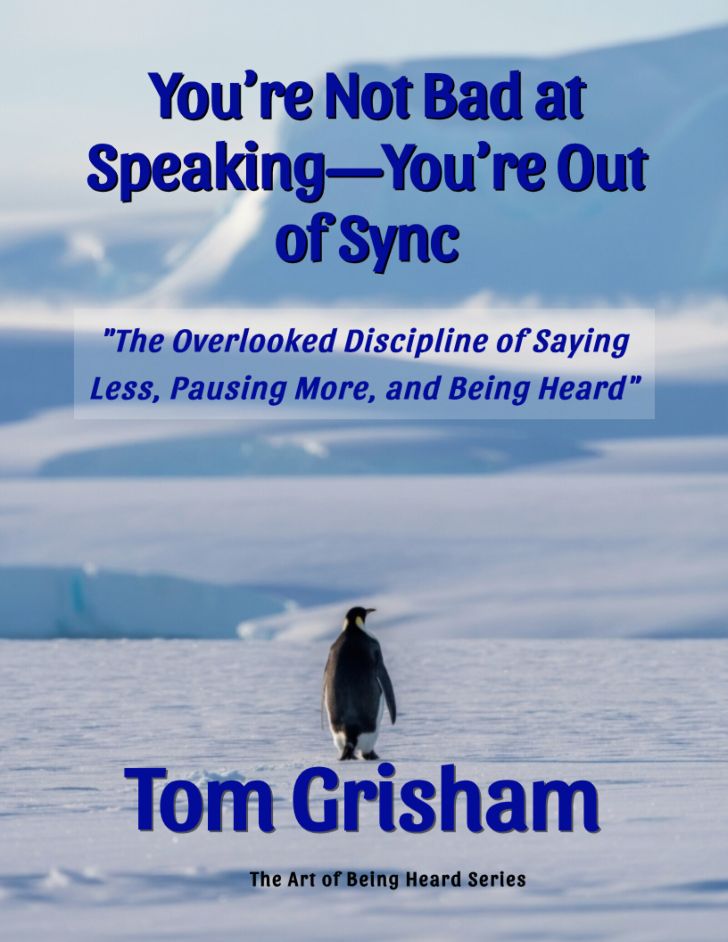
You’re Not Bad at Speaking—You’re Out of Sync
Have you ever noticed how some people can hold a room’s attention without ever raising their voice? It is a curious thing to watch. They don’t seem to be working particularly hard, yet every person in the room is leaning in, waiting for the next word to land. We often think these people were simply born with a gift, while the rest of us are left to struggle with shaky hands and a racing heart. But I’ve come to believe that good speaking isn’t a magic trick. It is simply a matter of getting back in sync with the natural rhythm of a conversation.
Most of us approach a speech or a meeting like it is a race we have to finish as quickly as possible. We pack our sentences tight, afraid that if we stop to breathe, we will lose our audience’s interest. This is what I call the “Noise Trap.” We think more words equal more authority, but usually, the opposite is true. When we speak too fast, we fall out of sync with the people listening to us. This book, You’re Not Bad at Speaking—You’re Out of Sync, was written to help you find that missing rhythm.
$1.01
Why is it that we feel the need to fill every empty second of a conversation with noise? We have been conditioned to believe that silence is a sign of weakness or a lapse in intelligence, but the truth is exactly the opposite. If you feel like your words are falling flat, it is likely because you are sprinting when you should be walking. My new eBook, You’re Not Bad at Speaking—You’re Out of Sync, is a quiet manifesto for anyone who wants to reclaim their voice by slowing down.
I remember watching a seasoned professor during a lecture years ago. He didn’t use notes, and he didn’t rush; he would simply say something important, then stop and look at us for five long seconds. That silence was heavier and more meaningful than any word he could have shouted. It was a rhythmic exchange, like breathing. This book is about finding that rhythm in your own life.
The Anatomy of a Shared Connection
Chapter 1: Five Celebrities Who Overcame Their Fear of Public Speaking
I once read about a world-famous actor who would get physically ill before every curtain call. Seeing how these household names moved from terror to triumph proves that your nerves are not a dead end, but a starting line.
Chapter 2: Speaking Plainly But Effectively: The Key to Success
Forget the multisyllabic jargon that sounds like a textbook. Think of the most helpful person you know; they likely speak in a way that a neighbor could understand over a fence, and that is where true influence lives.
Chapter 3: Research And Plan, Then Research Some More
Walking onto a stage without preparation is like trying to build a house on wet sand. When you know your subject like the back of your hand, you don’t have to worry about “performing” because you are simply sharing what you know.
Chapter 4: Speaking Techniques for All Situations
Whether you are giving a toast at a wedding or asking for a raise, the tools change but the foundation stays the same. We look at how to pivot your style without losing your soul.
Chapter 5: Visualization – The Key to a Good Speech
Close your eyes and see the room, hear the quiet, and feel the success before it happens. Athletes do this to win gold medals, and you can do it to win over a boardroom.
Chapter 6: The Power of a Pause
This is the “secret sauce” of the most captivating speakers in history. A well-timed pause gives your audience a moment to digest your last thought and wait with bated breath for your next one.
Chapter 7: Don’t Forget About Your Body Language
I once watched a man give a speech while hiding his hands in his pockets, and no one believed a word he said. Your posture and your eyes are the silent partners that tell the audience if you are telling the truth.
Chapter 8: Say Goodbye to Filler Language for Good
We use words like “um” because we are afraid of the dark spaces between sentences. Once you realize those spaces are your friends, those verbal crutches naturally start to fall away.
Chapter 9: Speaking With Confidence in the Era of Zoom and Other Digital Formats
Looking at a tiny green light on your laptop is a strange way to communicate. We discuss how to project warmth and authority when you are sitting in your home office.
Chapter 10: Practice Makes Perfect
There is no magic pill; there is only the repetition of the work. It’s like learning to play an instrument—eventually, the mechanics fade away and the music takes over.
Chapter 11: The Five Most Common Filler Words in The English Language
By identifying the specific “noise” you make when you’re nervous, you can begin to replace it with presence. We name these culprits so you can finally show them the door.
Chapter 12: It’s Not Just What You Say, But How You Say It
Think of the difference between a lullaby and a command. The melody of your voice is what reaches people’s hearts long before the logic of your words reaches their brains.
Chapter 13: Why Is Public Speaking Important
It is the primary way we move the world forward. When you speak well, you aren’t just making a point; you are inviting people into a better version of the future.
Chapter 14: To Speak or Not to Speak
You will find that sometimes the simplest, and most powerful thing you can do is to stay quiet. We will end by exploring the wisdom of having a simple unspoken word.
Related Products
Related products
-

The Person You’re Becoming Is Inconvenient
$0.99 -
Stop Fixing Yourself
$4.45 -
Purpose Isn’t a Lightning Strike
$4.45 -
The Practice of Hope
$4.45 -

The Practice of Change
$4.45 -
The Practice of Creativity
$4.45 -
The Practice of Words
$4.45 -
The Practice of Trust
$4.45 -
The Practice of Forgiveness
$4.45 -
Not Everything You Think, Should Be Said
$4.45 -
No One Cares About Your Speech Presentation
$4.45 -
The Practice Of Attitude
$4.45 -
The Practice of Now
$4.45 -
The Practice of Time
$4.45